Smart. Modular. Compact. Underwater sensing.

Opening up the seabed for the blue economy.

Discover the platform
What makes MOLA different

A new class of subsea instrument.

Most subsea observation platforms are large, heavy and single-purpose. MOLA flips that — a small, modular sensor lander you can deploy from a fishing boat and reconfigure for the job in front of you.

  • 01 / Compact

    Compact

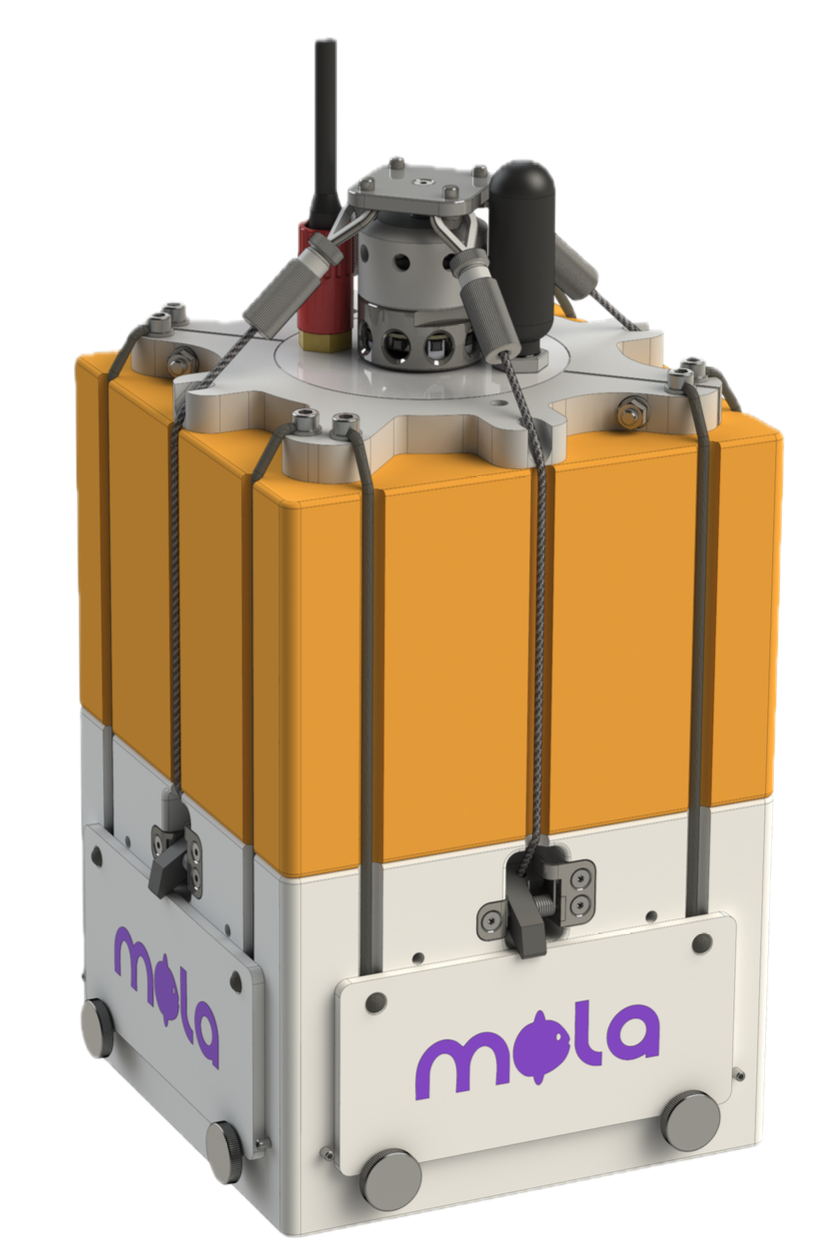
    21 × 21 × 32 cm, 12 kg. Deployable and recoverable from small vessels — no crane, no large research ship.

  • 02 / Modular

    Modular

    Swap sensors and accessories per mission — geophones, hydrophones, pressure, tilt, CO₂, CH₄ and more.

  • 03 / Smart

    Smart

    On-device machine learning runs on a microcontroller — earthquake detection, marine-mammal classification, anomaly flagging.

  • 04 / Networked

    Networked

    Acoustic modems link multiple landers into a self-organising underwater network for distributed monitoring.

The Modular Ocean Lander

Subsea observation, opened up.

The marine environment has a critical role to play in the energy transition from a carbon-based to a carbon-neutral society. Offshore wind, marine carbon capture and storage, and the protection of marine ecosystems all depend on detailed, ideally real-time information on subsea and seafloor processes.

Most current subsea observation platforms are large, heavy, single-function devices that demand significant infrastructure and financial investment — putting them out of reach for most users. MOLA is built to change that.

MOLA is a compact, modular sensor platform for monitoring geophysical, oceanographic and chemical parameters on the seabed. It currently integrates seismometers, hydrophones, inclinometers, pressure gauges, thermometers and CO₂ sensors — and because it is small enough to deploy and retrieve from small boats, it can be mobilised within hours.

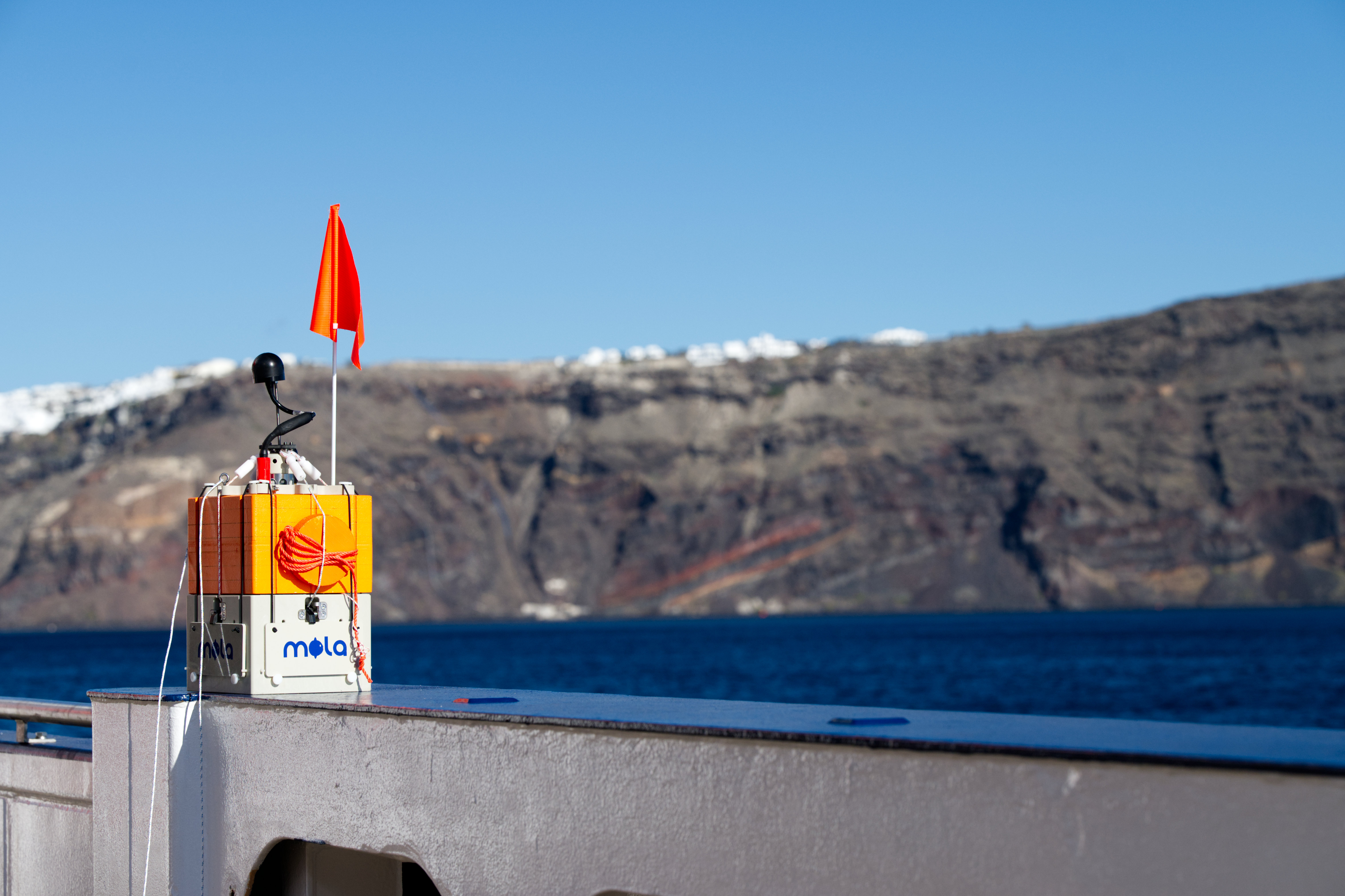
MOLA lander with caldera in background, ready for deployment offshore Santorini Santorini caldera · 2025
Smart Seafloor Monitoring

Intelligence at the seabed.

Multiple MOLAs form a communicating underwater network using integrated acoustic modems to transmit measurement data, analysis results and commands. Together with the University of Kiel and the MarData Graduate School, we have developed machine-learning data-analysis pipelines that are resource-efficient enough to run on microcontrollers.

LightEQ and SeismicSense are neural-network-based pipelines that enable on-device earthquake detection. We are also developing automated acoustic monitoring applications for detecting marine mammals and assessing the health of marine ecosystems.

Combined with resource-optimised network communication and distributed analysis, this enables intelligent seafloor monitoring and early-warning systems — a significant step beyond today's passive, non-networked marine instrumentation.

3D render of the MOLA lander MOLA · Rev. 2 render
Specifications

Compact, robust, ready for the deep.

MOLA is engineered for fast deployment and reliable performance down to 1 000 metres, with an acoustic modem for remote control and real-time data transmission.

Dimensions
21·21·32cm
Weight
~12kg
Max depth
1000m
Comms
Acousticmodem

Currently available

  • Geophones & hydrophones
  • Temperature, pressure & tilt
  • Chemical sensors (CO₂, CH₄)

Planned extensions

  • Current velocity, oxygen & turbidity
  • Active & passive sampling systems
  • Additional payload bays on request
MOLA in the field

From harbour soundscapes to volcanic crises.

MOLA has been tested in GEOMAR's facilities and during dedicated cruises aboard FK Littorina in Kiel Bay, and individual landers and small networks have been deployed during research cruises M198 (RV METEOR, offshore Sicily) and MSM132 (RV MARIA S. MERIAN, offshore Santorini).

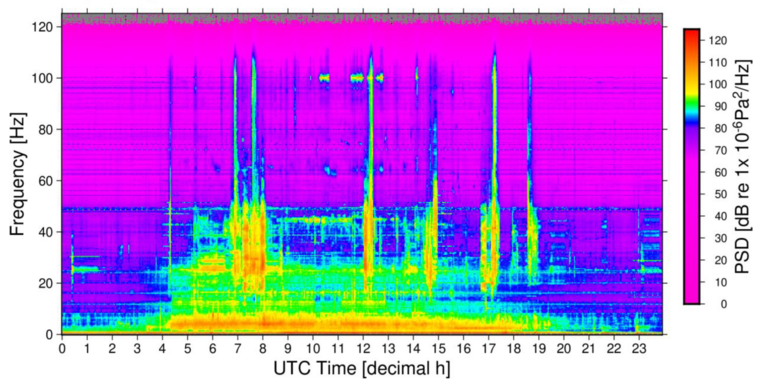
Soundscape spectrogram from Kiel harbour, showing frequency vs. time of day
Application 01 — Passive Acoustics

Measuring the soundscape in Kiel harbour

June 2023Naval Arsenal, Kiel2 landers · 3 weeks

Two MOLA landers were deployed for three weeks in the harbour basin of the Naval Arsenal to characterise the soundscape of Kiel Harbour using hydroacoustic and seismic measurements — the first multi-week proof of MOLA's potential for long-term passive acoustic monitoring.

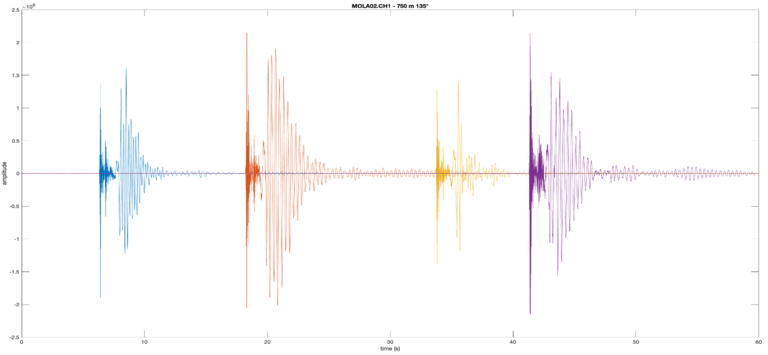
Recordings of underwater detonations across multiple channels
Application 02 — Seismic Monitoring

Underwater blasting, monitored end-to-end

September 2023Baltic Sea5 landers · 20 detonations

During a series of controlled underwater detonations carried out by the German Navy — including the disposal of unexploded ordnance — five MOLAs captured hydroacoustic and seismic recordings of 20 blasts. The data contributed to determining sound propagation through the water column and the seabed, and to quantifying the noise pollution of UXO disposal.

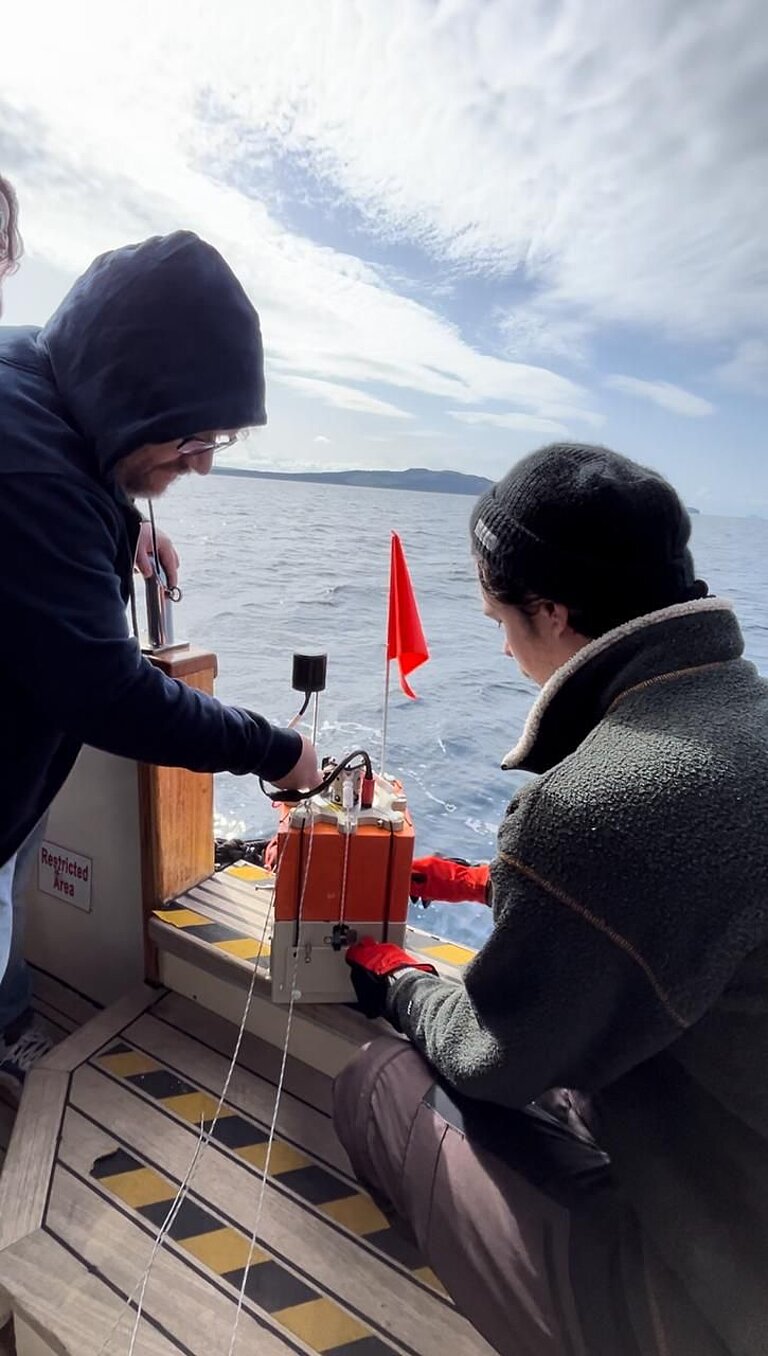
Researchers preparing a MOLA lander for deployment offshore Santorini Santorini caldera · Feb 2025
Application 03 — Rapid Response

Inside the 2025 Santorini earthquake crisis

February 2025Santorini calderaMULTI-MAREX project

As part of the MULTI-MAREX project, MOLA landers were installed in the Santorini caldera at the request of Greek partners to supplement the existing seismological network and investigate the seismic crisis in detail. MOLAs were ready for use within days — while comparable underwater stations could only be installed more than a month later.

Development & Partners

Built at , validated at sea.

Based on initial concept studies, MOLA has been funded by the Helmholtz validation project of the same name since May 2023. The system is designed and tested in GEOMAR's workshops and test facilities, with sea trials carried out from FK Littorina in Kiel Bay and during research cruises aboard RV METEOR and RV MARIA S. MERIAN.

GEOMAR
Helmholtz
Christian-Albrechts-Universität zu Kiel
MarData
MULTI-MAREX
Get in touch

Interested in deploying ?

We work with research institutions, industry partners and authorities on monitoring missions across geophysics, oceanography and the blue economy. Reach out to discuss campaigns, integrations or sensor extensions.

MOLA Project

Deployments · Partnerships · Sensor integrations

Email
info@mola-labs.ai
Legal notice